




9-9 Gen-Z Protest Day: Air Quality Worsens

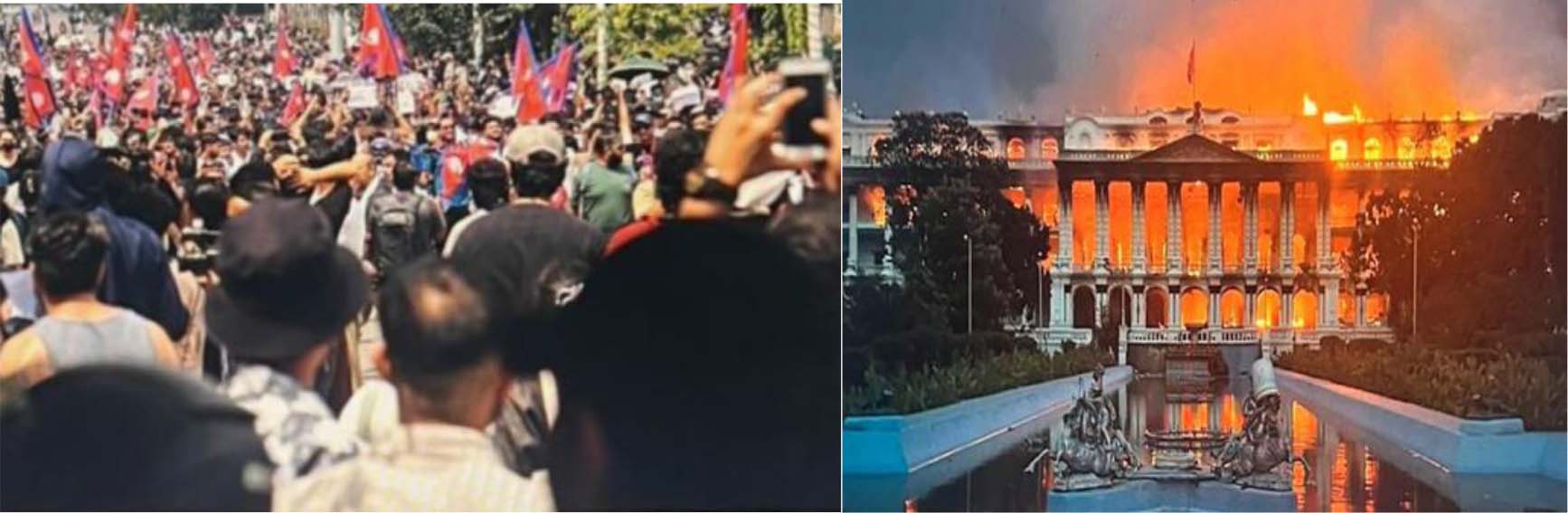



Pollution is the compact of various unhealthy materials that harms the people as well as the surrounding environment. In a World Bank report, it has indicated that outdoor air pollution alone kills roughly 5.7 million people globally each year due to its impacts on health, productivity, and life expectancy. It also said that leading environmental risk to health, causing 7 million premature deaths each year.
As countries are competing for economic growth, global pollution is rising. Also, due to population increases and hazardous environmental management pose serious health risks.
Besides, urbanization processes, vehicular emissions, brick kilns, and transboundary pollution have also contributed lots to pollute the environment. Every year over 4.5 million people face premature deaths as billions continue to breathe polluted air, stated in the UN reports,
Gen-Z Protest
This month on September 9, 2025 countrywide Gen-Z protests in Nepal saw many fires of the various buildings from government offices to private properties as well as burning tires have dramatically worsened air quality of the country (in Nepal), particularly, in the Kathmandu Valley and surrounding areas.
This has led to hazardous AQI levels and widespread health concerns that have consistently contributed to extremely poor air quality, with authorities calling for urgent, collaborative action to address the crisis.
With this, as WMO reported, Kathmandu ranked 6th most polluted city in the world on September 10, 2025 Wednesday noon (local time) with nearby cities like Pokhara also affected.
But whatever be happening, Nepal must be encouraged and aspire for the new dawn of good day that could drive the entire Nepali citizens’ life into the newer height.
Worse Air Quality
Nepal’s air quality was far worse than the World Health Organization’s safe air standards, making this a growing public health crisis. According to the data, air pollution has decreased the life expectancy of Nepalese by 4.1%.
While viewing the world report, India is the top most polluted nation in the world followed by Senegal and Italy as second and third. Nepal ranked fourth top most polluted nations in 2025.
In a World Bank report, the Kathmandu Valley and the Terai are Nepal’s air pollution hotspots, with no significant improvement over the past decade.
Nepal’s air pollution reduces life expectancy by 3.4 years for the average Nepali and causes approximately 26,000 premature deaths annually. In addition to health, air pollution impacts labor productivity, tourism, and the aviation sector. The economic cost of poor air quality is equivalent to more than 6 percent of Nepal’s Gross Domestic Product (GDP) each year.
No doubt, the polluted air can cause respiratory problems that could affect to heart disease and impair lung function.
While talking about non-polluted countries of the world, Bahamas topped the list of least polluted countries followed by French Polynesia, Iceland, Barbados and Finland for their clean air.
On the other hand, the Environmental Performance Index (EPI) has listed Estonia, Australia, Grenada, Iceland, Mauritius, and New Zealand as rank safest countries.
Because of strict regulations and high standards of public hygiene Germany, Luxembourg, Singapore and Switzerland are also cited cleanliness nations.
In Nepal, it is not safe to drink tap water whereas Iceland, Norway, Switzerland, Finland, New Zealand, Austria, Canada, and Singapore are listed as drinkable tap-water.
Pollution knows no boundary. The smoke coming out from vehicle and industrial emissions, household cooking, forest fires as well as transboundary pollution confirms a disturbing trend in air quality loss.
Measures To Better Air Quality
Bad air pollution leads to premature death and causes various health disabilities. More greenery and electrical vehicles could boost better air quality for better health and longer life expectancy.
As climate change and air quality go hand-in-hand single-sector solutions are not sufficient to meet any clean air target. To tackle public health threats, multi-sectoral and multi-regional nature, better public policy and sound investment are needed to be optimized for qualitative air quality.
File Photo: Gen-Z Protestors and Burning Singh Durbar